Written by: Lydia Styf / Spill editor & Kyran Waggoner / Staff writer
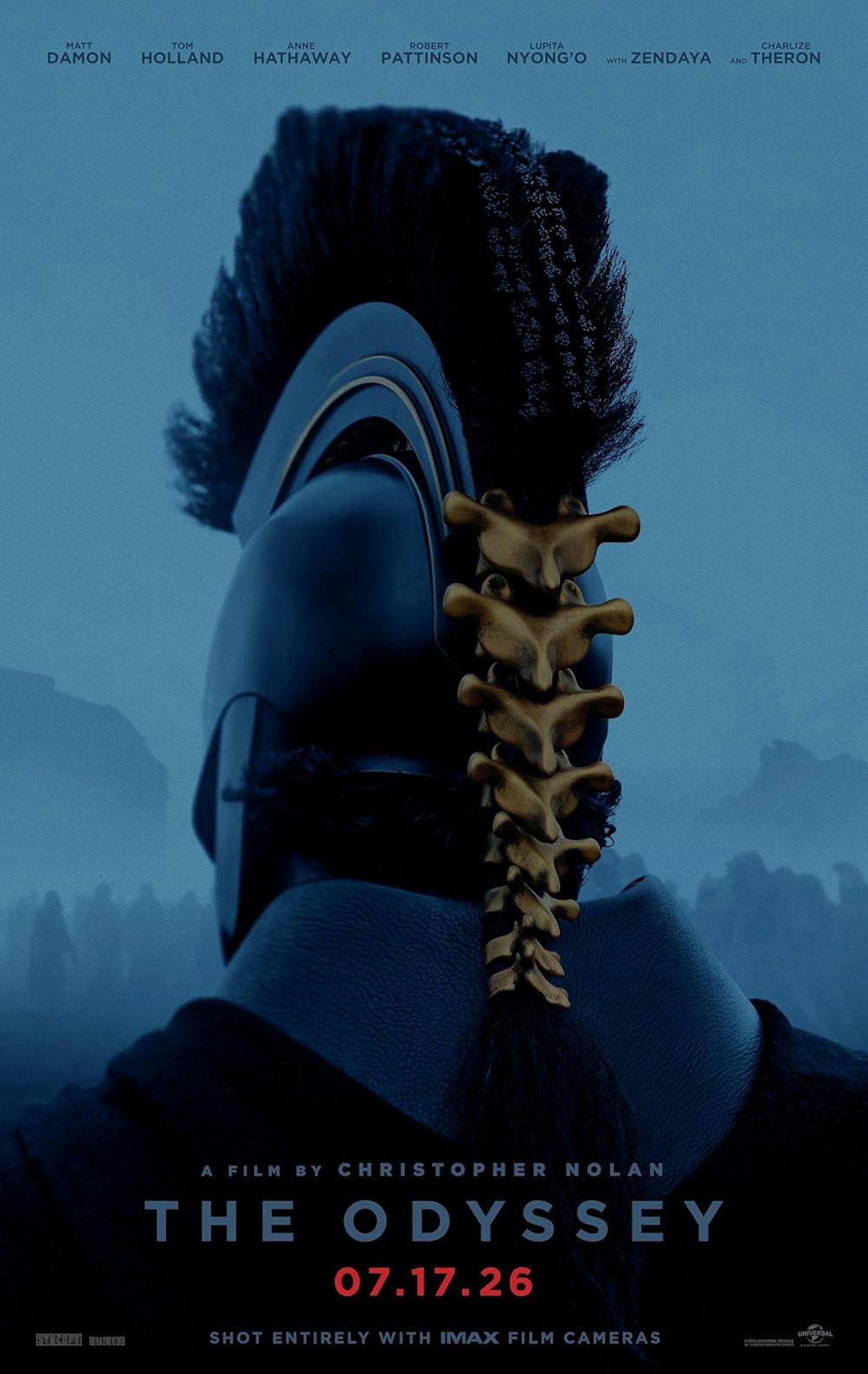
Christopher Nolan’s new film “The Odyssey” released over the summer, was Hollywood’s newest adaptation of Homer’s original work. The story follows Odysseus of Ithaca (Matt Damon) as he makes his way home from the Trojan war to Penelope , his wife (Anne Hathaway) and son, Telemachus (Tom Holland).
While most of the story takes place after the war is over, many scenes are present that reference or show what occurred before and during it. For instance, the first scene presented is a retelling of Odysseus’s genius with the gift of the trojan horse, the first of many practical effects used by Nolan.
Nolan–known for his use of practical effects–actually put all of the actors on a giant horse, using camera angles to perfect the scenes. For the scenes of soldiers drowning, the actors submerged themself in the water
In the horse’s introduction we are shown Sinon (Elliot Page), the human bait that allows for the victory. During production, many people mistaken Page’s role for Achilles, this rumor spread like wildfire due to people not doing enough research. People compared Page to Brad Pitt as Pitt played Achilles in the movie “Troy”.
Though false, this rumor was just one more controversy in the film’s production.
Agamemnon’s role–while small–was very effective. In the scene where the doors of Troy are opened, his figure, bigger than anyone else, slowly walks in as an unstoppable force. His presence is also vital to the introduction of Helen of Troy (Lupita Nyong’o). Her sister, Clytemnestra (also played by Nyong’o) is married to Agememnon upon his return from the war.
In a retelling told to Telemachus, it is shown that Clytemnestra killed him for the murder of her daughter, which felt very important to me as a way of showing the humanity of the people not only in the Trojan War, but those left behind as well.
However, the casting of a black woman to play “the most beautiful woman in Greece” became a large issue with netizens. They cited “accuracy” and the fact that a black woman would not exist in ancient Greece, despite the fact that no one in the main cast is from the Mediterranean.
Another detail I enjoyed was the decision to make Athena (Zendaya) a representation of Odysseus’s guilt, rather than simply a goddess that helps him in his journey.
However, we see the journey from Troy to Ithaca is told not through a fluid story, but rather through a retelling as Odysseus recalls it to Calypso (Charlize Theron).
Polyphemus’s island was one of the best parts of the journey back. Once again, Nolan’s preference for practical effects is shown here, Polyphemus himself was either a puppet or a man in costume depending on the scene. One big part they cut out from the movie was Odysseus’s trick with referring to himself as “Nobody”. Although it was absent, this section of the story was done very well.
Next, they encountered the nymph Circe (Samantha Morton) who transformed the men into pigs. While the timeline was shortened and the crew only stayed on the island for a few hours as opposed to the year in the original story, the body horror is highly effective in showing the reality of the journey.
In between islands on Odysseus’ crew is shown in the ocean on their boat, all these scenes were really filmed on a boat in the ocean, some wide shot scenes using a smaller model. There is even one shot with a dolphin that was entirely unplanned, but remained in the film due to its realism.
Practical effects became the highlight of the film, even going so far as to cast real “giants” to play the Laestrygonians while Odysseus’s stunt double was Devyn Dalton, a 4’6” woman.
However, Nolan was not the only one set on realism. Hathaway learned how to use a traditional loom so that her scenes would look as realistic as possible. Her portrayal of Penelope–a wife that not only longs for her husband’s return, but takes active part in keeping her kingdom afloat without him.
The suitors, led by Antinous (Robert Pattenson) are a perfectly acted, disgusting group of men that did their part in upsetting the audience every time they appeared on screen. From insulting and threatening Telemachus, to abusing Odysseus’s hunting dog–Argos.
Argos was the part of the movie that made me most excited, as all of my personal favorite retellings of the story omit his role due to time, convenience, or simply impracticality. Allowing Odysseus to pet his dog one last time before his revenge on the suitors attempting to steal his family was my personal favorite part of the movie.
However, the piece that immediately follows it is a beautifully filmed massacre that perfectly shows who Odysseus has become. He instills fear in the suitors, while giving his wife, son and friends the hope that comes with the return of their king.
It also provides a perfect final characterization of everyone that remains in the story. They all trust that Odysseus will save the palace, but they also know that it calls for slaughter.
It allows for the story to come to a perfect close where Odysseus is able to see his palace, kingdom, son and friends before his exile for breaking “Zeus’s Law”, a driving force throughout the film. From the trick of the Trojan horse, to Circe’s transformation of the crew and eventually Odysseus’s slaughter of his guests, Zeus’s Law hangs over the story.
Finally, Nolan’s cinematography all comes together in his choice to film the movie for IMAX, a screen that is only available two places in the Indianapolis area. While many people complained about how this disrupted their viewing experience, I believe that it only made it better, especially if you were able to see it on the IMAX screen.